
Libby Heaney's Quantum Computing Exhibition absolutely BLEW MY MIND!!
I had the pleasure of attending Libby Heaney's incredible quantum computing art exhibition - Shadowscapes: Heaney, JMW Turner and Quantum. I've got to tell you all about it!

Just last week, I had the absolute privilege of attending Libby Heaney’s quantum computing-style art exhibition, which featured her out-of-this-world works alongside some famous works from Joseph Turner. It was a collaboration that you’d never even fathom were possible, and it works sublimely well. By pairing the inherently random and chaotic world of quantum with the Romantic, subtle and composed landscapes of Turner, it felt as though I was able to appreciate a new depth to the philosophy of Quantum. This exhibition provokes your mind, your senses and breaks the limited confines of your perceptions. It challenges your understanding of the quantum universe and forces you to confront the very nature of our world. In the quantum world things are hidden, uncertain, fluctuating and random - and yet a certain defined beauty is formed from this - with certain genius one can capture it.
Let’s talk about what I saw. But first… a much needed introduction.
Libby Heaney
Heaney is known as the first artist globally to use quantum computing as her artistic medium, beginning in 2019. Her work has been presented in exhibitions within the UK, in New York, Barcelona, Beijing, Frankfurt and more - she is an international pioneer. Some of her solo shows have been held at HEK Basel in Switzerland, LAS Art Foundation in Berlin and Somerset House in London. Between 2015 and 2019, she held an academic position at the Royal College of Art in London. In 2022 she won the Lumen Prize, among many others. Heaney’s work expands the horizon for how contemporary art can engage and interact with the world of quantum.
Before turning to art, though, Heaney trained as a scientist. She holds an MA in Art & Science from Central St. Martins, an MSci in Physics with German from Imperial as well as a PhD in Theoretical Quantum Information Science from the University of Leeds. As as post-doc, she has held research positions and fellowships at the University of Oxford and the National University of Singapore. Her academic papers have featured in some of the best scientific journals there are, such as Physical Review Letters and New Journal of Physics. This extensive scientific background is not only impressive but also massively contributes to her artistic process.
To learn even more about Libby Heaney you should visit her website.
The Shadowscapes Exhibition at Orleans House Gallery
As you arrive at Orleans House and you enter the reception, there is a loud booming sound that catches your attention. It’s originating from this beautiful room:
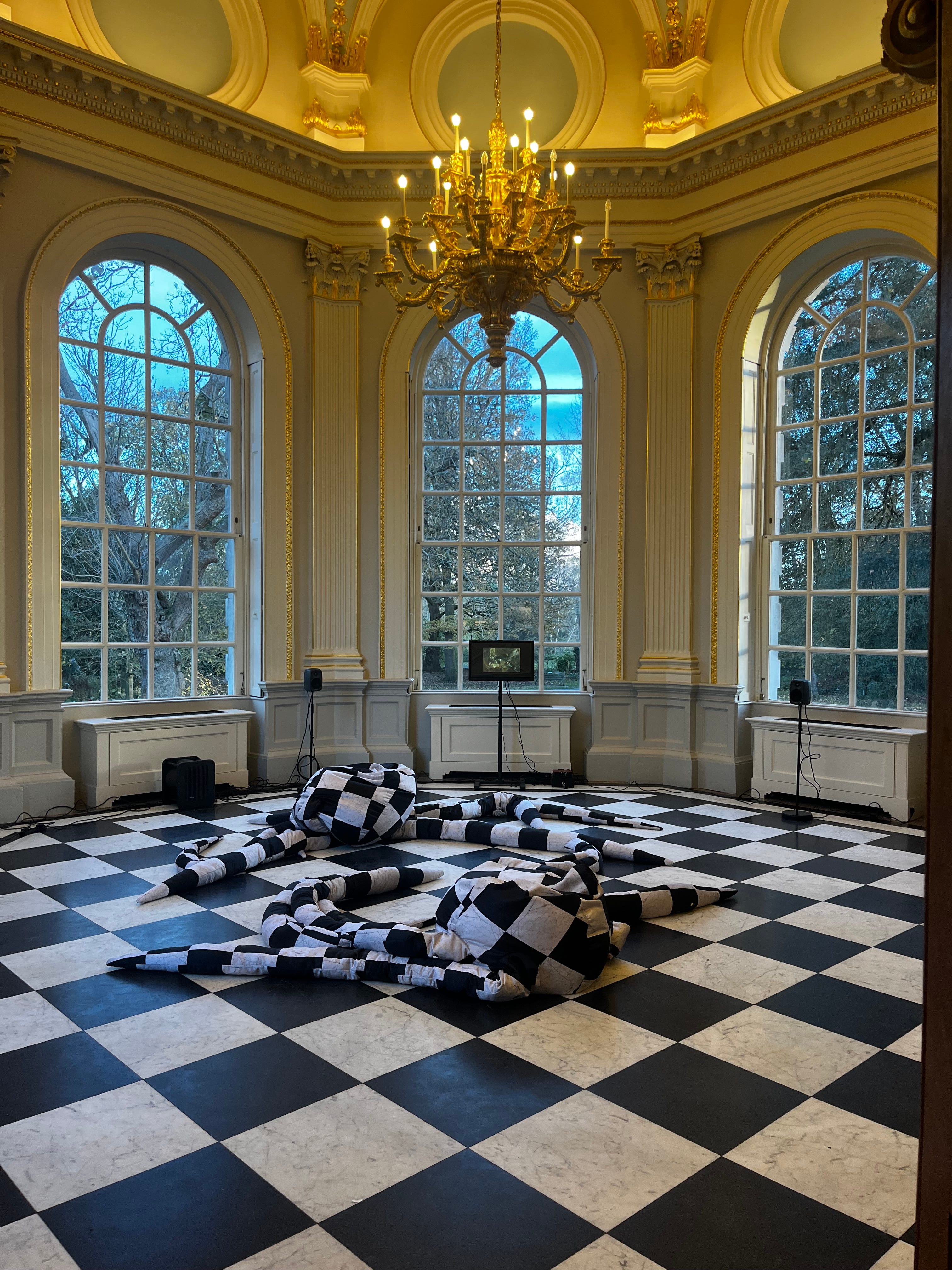
It was captivating. The way I interpreted it was this: I saw entangled particles on the floor. Much as how small sub-atomic particles or qubits within a quantum computer can become entangled, this entanglement could be seen as ‘tentacles’ stretching between the particles. Once particles or qubits are entangled, they cannot be described individually and furthermore they can be affected at the same time instantaneously. A process like decoherence, which I have explained before, is the breakdown of a quantum state - it could be thought of as analogous to shredding the link between the ‘tentacles’. This was a great start to the exhibition, and I felt myself being beckoned into the next room. This one was a lot darker, perhaps a little sinister, yet mysterious and exciting. Here, I found some incredible paintings:


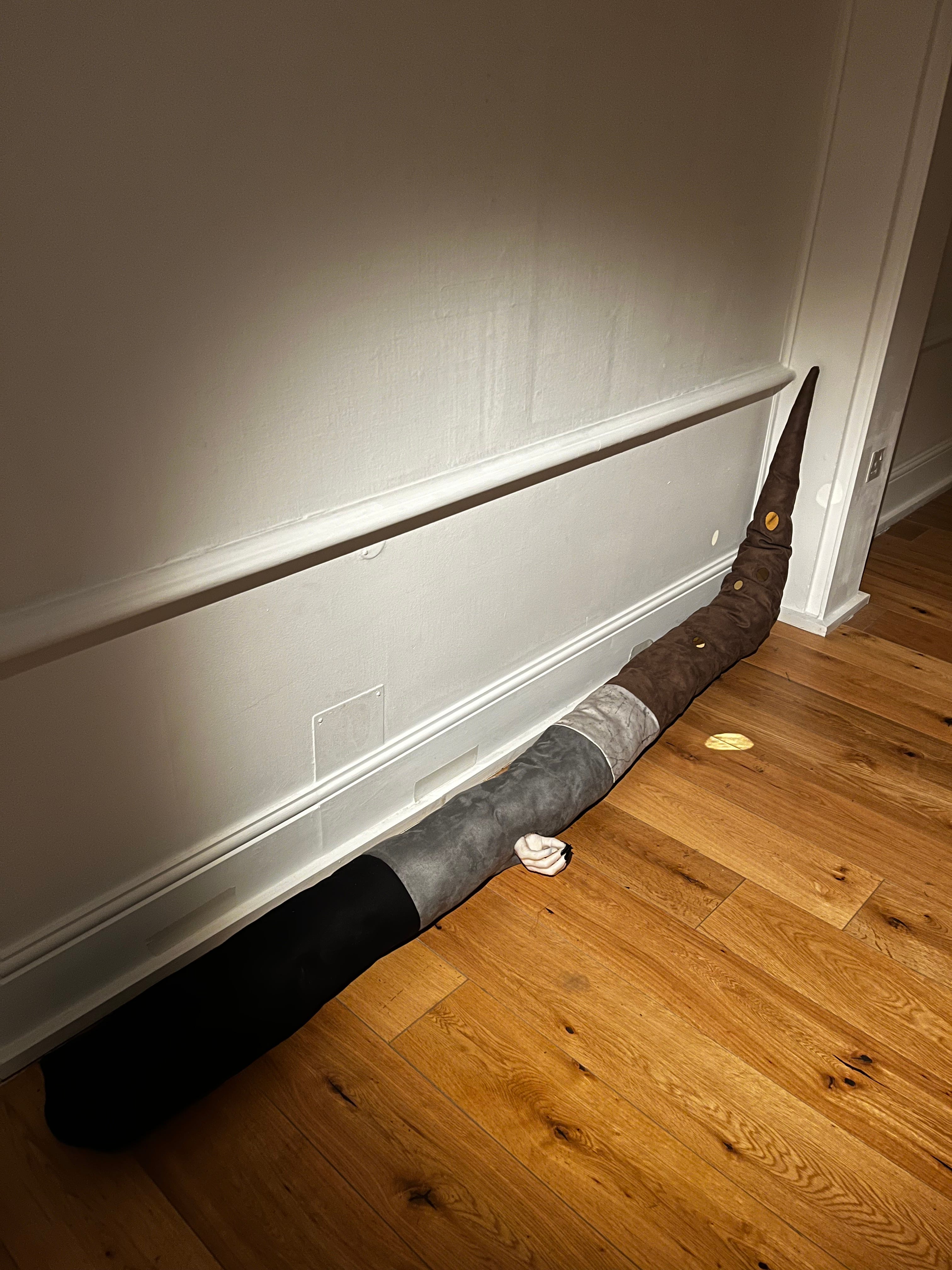
The mixture of Turner’s stunning works with the captivating allure of Heaney’s art was majestic. Some of Turner’s work genuinely took me aback - there is such a raw and flowing expression from his pieces. Crashing waves and turbulent winds can almost be felt and heard, the sea spray can almost linger on the nose. Meanwhile, roaring fires and coastal backdrops stir deep emotions and flood the mind with landscape imagery. Heaney’s work challenges the eyes and surpasses conservative notions, whilst I liked to compare her square canvas works to atomic nuclei or cells from a living organism - my parents saw souls and spiritual energy. One thing that remains consistent with Heaney is the theme of hands with claws. One may find that within her paintings and her larger physical works. Particularly, I also found floral and tree-like depictions within her expressions - as if to almost dive into the cross section of a large trunk.
The journey at Orleans House Gallery is tumultuous and rocky - you will rarely find yourself composed. One of the highlights was an AI-powered piece, it is not something I have ever seen before:
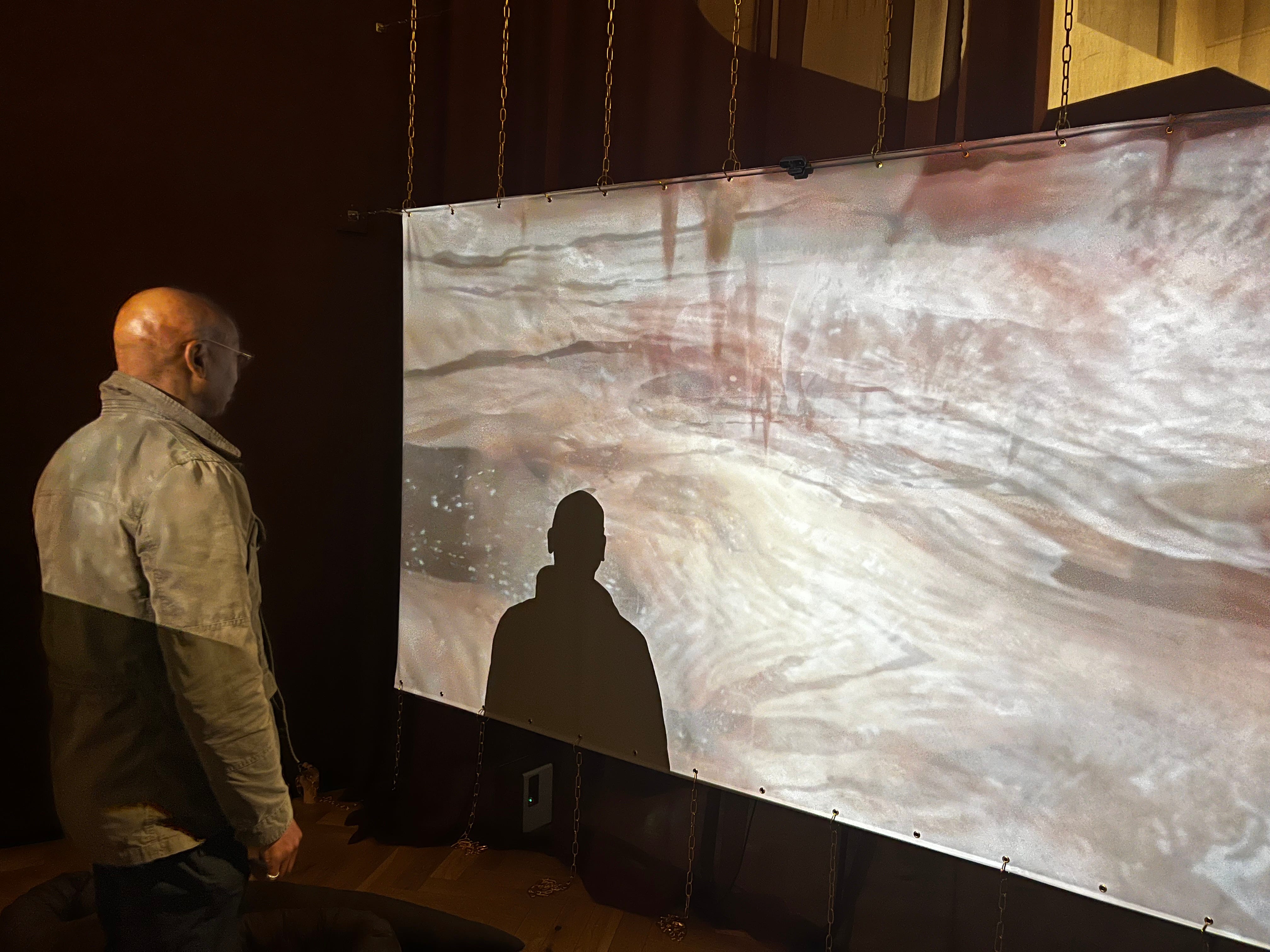
Hung from chains, a screen showed an indescribable plethora of worlds, evolving and swirling and chaotically manifesting. First caves and stalactites, then thorns and bushes scattered on volcanic plains. Next universes and stars colliding with heavenly ascents and then suddenly dark reflections of yourself mirrored ad infinitum. I mean this literally. A camera was fixed above the screen such that the image of yourself would become incorporated into the display. It might choose to zoom in to your lips, your legs or your hands, twisting and knitting a visual narrative in real-time. I should imagine that taking certain drugs could recreate this experience - it was surreal and had an eerie beauty about it.
The music that accompanied could not be put into genre. And that was precisely what I loved about this entire experience in a sense. It is refreshing and necessary to go outside of your normal bounds and experience new things.
How I interpret Shadowscapes take on Quantum Computing
Generally, the world of physics is rather binary. Even though countless theories are overturned and at the highest levels of the field, interpretations vary wildly - traditional physics tends towards consensus. Physicists enjoy consensus and agreement. But the world of quantum computing will not allow this, inherently. Quantum mechanics describes the fundamental disorder of our universe, particles can seemingly become waves or particles at a whim. Electrons are not found at a particular location, but instead exist in a clouded probability - uncertain about where to show up. As one tries to measure a particular property of a quantum particle, the precision of other measurable properties seemingly disappear. Or take, superposition and entanglement - quantum properties in which a quantum state exists in a combination of many possibilities or where the constituents of a quantum state are linked and correlated.
These unintuitive theories and observations of our universe challenge conventional physics. In this way, therefore, I see Shadowscapes as an excellent impression of quantum mechanics and quantum computing. Qubits are unreliable at times and can randomly fail due to interference with the natural environment (noise). As we perfect the art of containing and controlling quantum things, it will nevertheless always be the case that their innate nature is chaotic.
There’s something beautiful about that - things aren’t predetermined in the world of quantum. They are chaotic.